
Philippine organizations in both the public and private sectors continue to experience structural challenges arising from fragmented human resource (HR) data environments. Core HR information—such as employee records, payroll data, attendance logs, performance evaluations, training histories, and compliance documentation—is frequently dispersed across multiple systems, spreadsheets, and manual records. While such fragmentation has often emerged incrementally through historical and operational constraints, its consequences have become increasingly significant. These include inconsistent reporting, heightened audit and compliance risks, diminished confidence in HR decisions, and limited capacity for evidence-based workforce planning (OECD, 2020; UNDESA, 2021). As organizations confront growing complexity, regulatory scrutiny, and expectations for transparency, fragmented HR data architectures increasingly undermine effective governance and strategic decision-making.
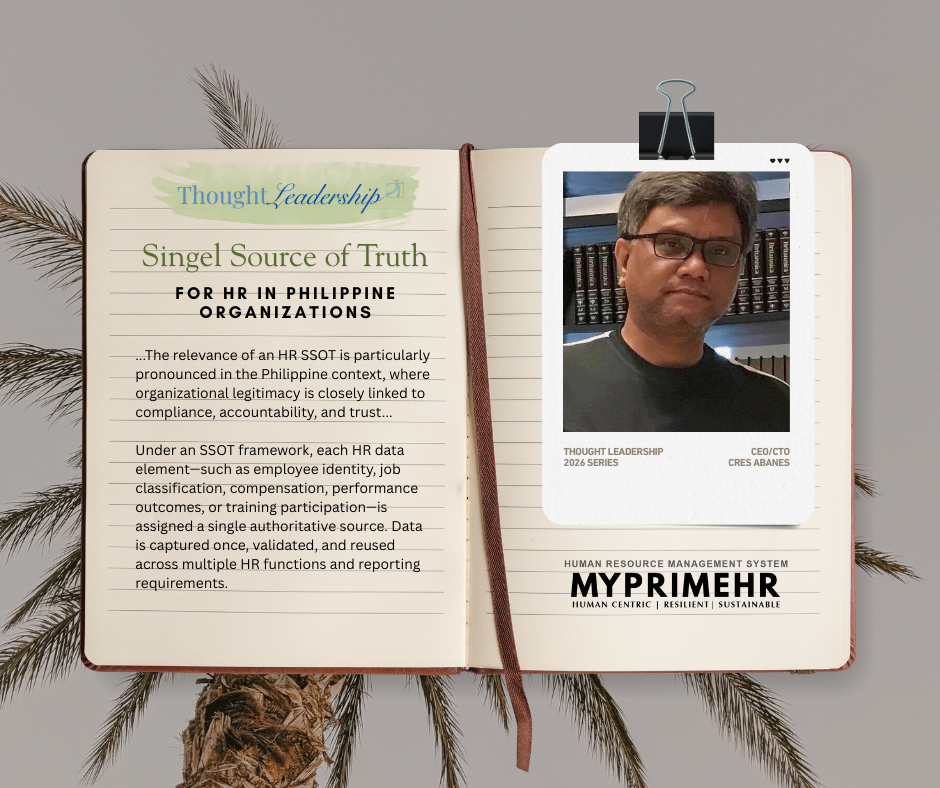
A Single Source of Truth (SSOT) for HR represents a structural response to these challenges by establishing one authoritative, consistent, and reliable foundation for all workforce-related data. Conceptually, SSOT extends beyond the technical notion of centralized databases. It is fundamentally a governance principle supported by institutional rules, standardized processes, and enabling technologies (ISO, 2018). Under an SSOT framework, each HR data element—such as employee identity, job classification, compensation, performance outcomes, or training participation—is assigned a single authoritative source. Data is captured once, validated, and reused across multiple HR functions and reporting requirements. This approach minimizes duplication, reconciliatory work, and interpretive discrepancies, thereby strengthening data integrity and organizational confidence in HR information (OECD, 2019).
The relevance of an HR SSOT is particularly pronounced in the Philippine context, where organizational legitimacy is closely linked to compliance, accountability, and trust. In the public sector, HR data forms the evidentiary basis for Civil Service Commission (CSC) reporting, PRIME-HRM maturity assessments, internal and external audits, and merit-based personnel actions (Civil Service Commission [CSC], 2018). In the private sector, HR data directly influences payroll accuracy, labor law compliance, employee relations, and executive oversight. In both contexts, inconsistent or unreliable HR data exposes organizations to operational inefficiencies, legal risks, and reputational harm. By contrast, an SSOT provides clear data lineage, audit trails, and reporting consistency, thereby reinforcing institutional accountability and governance effectiveness (UNDESA, 2021).
Within the Program to Institutionalize Meritocracy and Excellence in Human Resource Management (PRIME-HRM) framework, a Single Source of Truth functions as a critical enabler of HR maturity progression. PRIME-HRM emphasizes merit-based recruitment and selection, data-driven learning and development, objective performance management, and transparent rewards and recognition systems (CSC, 2018). These principles presuppose the availability of accurate, integrated, and verifiable HR data across the employee lifecycle. In the absence of an SSOT, agencies often remain confined to transactional or process-defined maturity levels, where HR activities are compliance-oriented and retrospective. The establishment of an SSOT allows HR data to be integrated across functional boundaries, supporting movement toward strategic and transformational maturity levels characterized by analytics-driven decision-making and sustained organizational learning (OECD, 2020).
An SSOT is likewise foundational to compliance with ISO 30409 on Workforce Planning, which underscores the importance of continuous, competency-based, and forward-looking workforce analysis. Effective workforce planning requires reliable historical data on workforce size, composition, competencies, attrition, and retirement patterns, combined with timely updates and scenario-based modeling (ISO, 2016). Without a Single Source of Truth, workforce planning tends to rely on fragmented datasets and manual spreadsheets, limiting its analytical rigor and predictive value. By contrast, an SSOT enables organizations to conduct systematic workforce supply and demand analysis, identify skills gaps, assess workforce risks, and evaluate alternative planning scenarios using consistent and defensible data (OECD, 2019).
Similarly, ISO 30414 on Human Capital Reporting depends on the systematic availability of high-quality HR data. ISO 30414 specifies a set of standardized human capital metrics across areas such as workforce costs, productivity, diversity and inclusion, leadership capability, health and safety, and compliance (ISO, 2018). The credibility of these metrics is compromised when data is manually consolidated from disparate systems or reconciled through ad hoc processes. An SSOT supports the sustainability of ISO 30414 reporting by ensuring that all disclosures are derived from a single authoritative data foundation, thereby enhancing reporting accuracy, audit readiness, and leadership confidence in human capital information (UNDESA, 2021).
Taken together, PRIME-HRM, ISO 30409, and ISO 30414 constitute an integrated governance architecture for modern HR management. PRIME-HRM articulates national expectations for HR professionalism and maturity, ISO 30414 defines the scope and structure of human capital measurement and reporting, and ISO 30409 provides methodological guidance for workforce planning. A Single Source of Truth serves as the connective infrastructure that operationalizes alignment across these frameworks. In the absence of SSOT, compliance with these standards risks becoming superficial and episodic; with SSOT, alignment becomes systematic, strategic, and sustainable (OECD, 2020).
Beyond standards compliance, the implementation of an HR Single Source of Truth carries significant implications for leadership and organizational culture. In Philippine organizations, perceptions of fairness, transparency, and procedural integrity are central to employee trust and institutional legitimacy. Persistent payroll errors, inconsistent records, and opaque HR decisions undermine confidence in management and weaken organizational cohesion (CSC, 2018). An SSOT reinforces procedural fairness by ensuring that HR decisions—such as promotions, training allocations, and rewards—are grounded in consistent, verifiable data. This strengthens meritocratic practices, enhances employee trust, and legitimizes leadership authority (UNDESA, 2021).
In sum, the establishment of a Single Source of Truth for HR represents a paradigmatic shift in the role of human resource management within Philippine organizations. It repositions HR from a predominantly administrative and compliance-oriented function toward a strategic governance role capable of supporting evidence-based leadership and long-term workforce readiness. In the context of ongoing public sector modernization, digital transformation, and heightened accountability expectations, an HR SSOT is no longer optional. It constitutes a foundational institutional investment that underpins compliance, strengthens trust, and enables data-driven, resilient, and future-ready organizations.
References:
Civil Service Commission. (2018). Program to institutionalize meritocracy and excellence in human resource management (PRIME-HRM) framework. Civil Service Commission, Republic of the Philippines.
International Organization for Standardization. (2016). ISO 30409: Human resource management—Workforce planning. ISO.
International Organization for Standardization. (2018). ISO 30414: Human resource management—Guidelines for internal and external human capital reporting. ISO.
Organisation for Economic Co-operation and Development. (2019). Strategic human resources management in government: A comparative study. OECD Publishing. https://doi.org/10.1787/9b7a3a58-en
Organisation for Economic Co-operation and Development. (2020). Public employment and management 2020. OECD Publishing. https://doi.org/10.1787/1a58c5b8-en
United Nations Department of Economic and Social Affairs. (2021). World public sector report 2021: Rebuilding public service after COVID-19. United Nations.
Single Source of Truth for HR in Philippine Organizations
Share this article
Keep exploring
Browse more articles
More from the myPrimeHR community
Browse more articles and ideas for building better workplaces.